



 Electronics
  Sports
  Automotive
  Stationery, Books & Music
  Lifestyle
  Fashion
 _20.jpeg) Home
Home  Garden & Pet Care
  Grocery
  Electronics
  Sports
  Automotive
  Stationery, Books & Music
  Lifestyle
  Fashion
 _20.jpeg) Home
Home  Garden & Pet Care
  Grocery
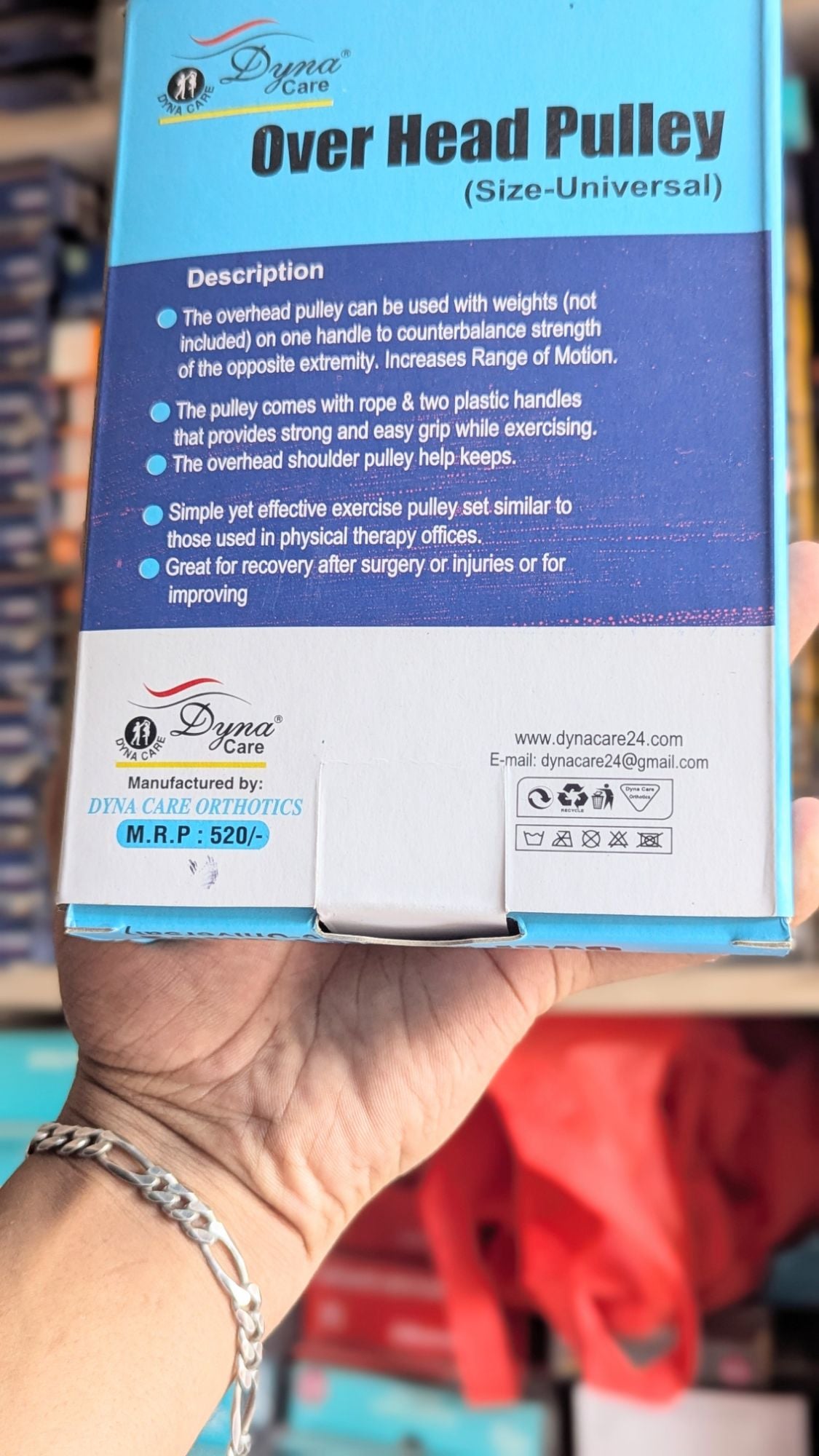








An overhead pulley (sometimes called an overhead lifting pulley or ceiling-mounted pulley) is a mechanical device used to lift, lower, or move heavy loads vertically or horizontally by changing the direction of force applied through a rope, cable, or belt. It typically consists of a wheel with a groove along its edge (called a sheave), which is mounted to a fixed point above the load.
Description of an Overhead Pulley:
Structure:
Pulley wheel (sheave): Rotating wheel with a grooved rim to guide a rope or cable.
Frame or housing: Encloses or supports the sheave, often made of metal for strength.
Mounting system: Hooks, brackets, or bolts secure the pulley to a ceiling, beam, or support structure.
Rope or cable: Runs through the sheave and connects to the load being moved.
Function:
Changes the direction of force, allowing a person or machine to lift or move a load with less effort.
Often used in combination with other pulleys to form a block and tackle system, which increases mechanical advantage.
Common Applications:
Garages and workshops – for lifting engines or heavy tools.
Gyms and fitness equipment – for resistance machines.
Theatrical rigging – to raise and lower curtains or scenery.
Warehouses and construction sites – for hoisting materials.
Advantages:
Reduces strain when lifting heavy objects.
Allows lifting from awkward angles or tight spaces.
Increases efficiency and safety in manual handling tasks.
Let me know if you're referring to a specific type of overhead pulley (e.g., gym pulley, industrial hoist pulley, etc.), and I can tailor the description further.

Login to ask a question
