



 Daily Bazar
  Electronics
  Mother, Baby & Toys
  Beauty
  Sports
  Automotive
  Stationery, Books & Music
  Special Weekly Offer
  Global Finds
  Quick Commerce
 _20.png) Fashion Luxe
Fashion Luxe  Sports Shoes
  Fashion
 _20.jpeg) Home
Home  Garden & Pet Care
  Grocery
  Daily Bazar
  Electronics
  Mother, Baby & Toys
  Beauty
  Sports
  Automotive
  Stationery, Books & Music
  Special Weekly Offer
  Global Finds
  Quick Commerce
 _20.png) Fashion Luxe
Fashion Luxe  Sports Shoes
  Fashion
 _20.jpeg) Home
Home  Garden & Pet Care
  Grocery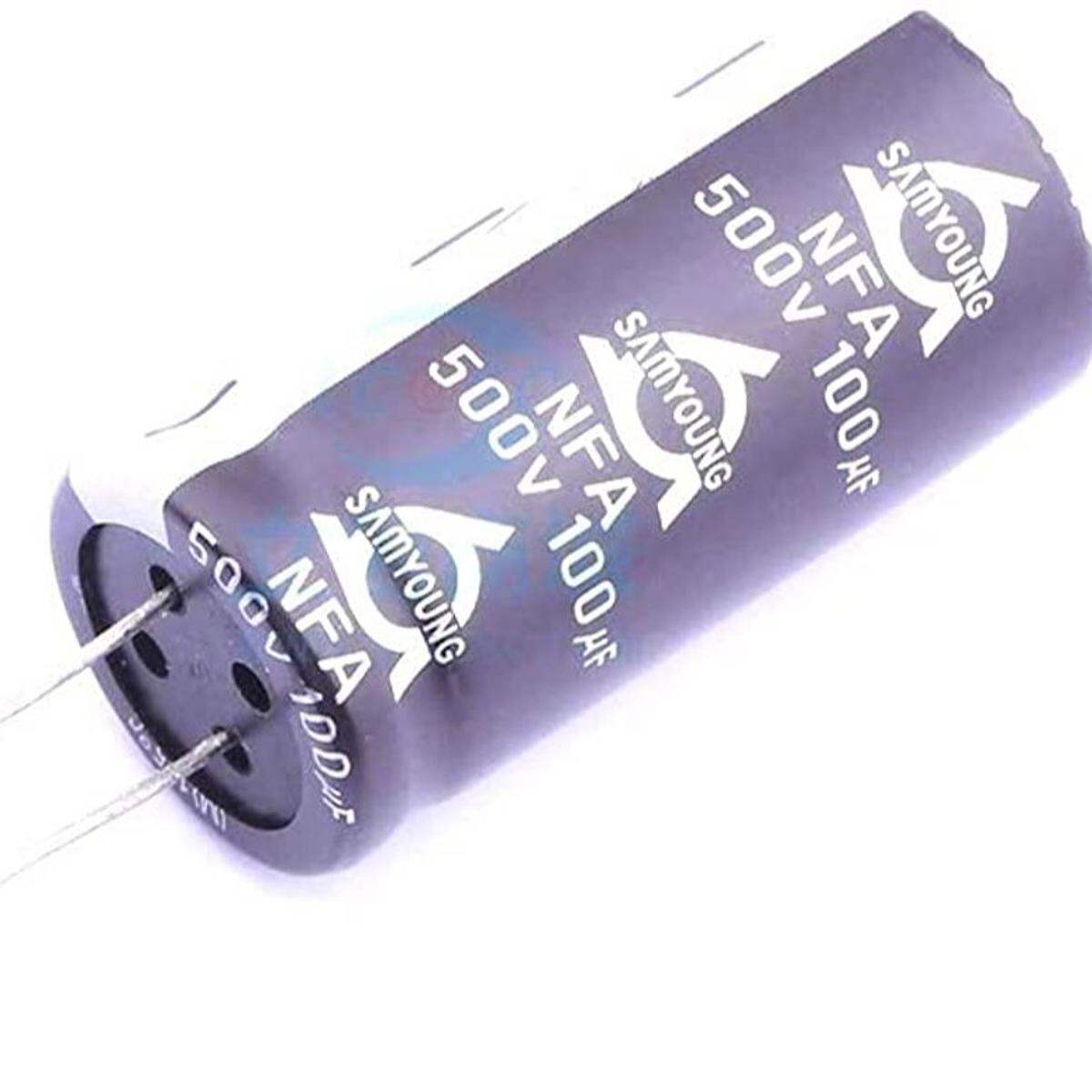
Description: RADIAL 100uF 500V Electrolytic Capacitors
RADIAL 100uF 500V Electrolytic Capacitors 100uF 500V Radial Polarized Aluminum Electrolytic Capacitor THT Electrolytic Radial Capacitors Electronics Circuitry & Parts
An electrolytic capacitor definition is, it is a polarized capacitor whose anode has a higher or more positive voltage than the cathode. As the name suggests it is a polarized capacitor and an electrolytic capacitor function is, it uses an electrolyte to operate with a higher or more positive voltage on the anode than the cathode. Therefore, the anode terminal is denoted with a positive sign, while the cathode with a negative sign. Applying a reverse polarity voltage of 1 to 1.5 volts may destroy the capacitor and dielectric and the result is hazardous, leading to an explosion or fire.
An electrolytic capacitor uses an electrolyte, in the form of solid, liquid or gel – serves as cathode or negative plate to achieve much higher capacitance per unit volume. On the other hand, a positive plate or anode made of metal acts as an insulating oxide layer formed through anodization. This allows an oxide layer to work as the dielectric of the capacitor.
Specifications:
Capacitor Type: Electrolytic
Mounting: THT
Capacitance : 100uF
Voltage-Rated : 500V
Tolerance : ±20%
Features : Standard General Purpose
Maximum Temperature : 105°C
Size: 45x15mm
Features:
High Temperature Type with Excellent Ratings
Long Life
Low Leakage Current
Easy Mounting
RoHS Compliant
Snap-in terminals
High ripple current
Low ESR
Stable and reliable performances
Uses/Applications:
Used in filtering applications to reduce the ripple in the power supplies
Used as a low pass filter to smoothen the input and output signals
Used in audio amplification circuits as filters to reduce hum
Used in electronic circuits for coupling, decoupling bypass and filtering
Electrolytic Capacitor is ideal for crossover networks, speaker boxes and other audio projects.
Used to achieve high capacitance value
Used in low-frequency applications

Login to ask a question
